

Dr. Mohammad A-Masri; Ph.D.; Audiology Department; Al-Ahliyya Amman University
Abstract
Objectives: The aims of this study are to establish and validate a Dizziness Handicap Inventory of Jordanian Arabic language (DHI-JA) equivalent the DHI of English language (DHI-E). Methods: The THI-E questioners were translated into formal Jordanian Arabic language by two bilingual audiologists’ volunteers. The final version was developed by the author. Then the final version was applied on 20 normal balance participants and 64 dizziness patients at the Middle East Hearing and Balance Centre. Results: The results illustrate an excellent internal consistency and reliability of DHI-JA. There is a high significant correlation between total scores and sub-scores of the DHI-JA and the DHI-E. There is also significant correlation between Beak Depression Inventory, the State Anxiety Inventory and the total scores and subscales of developed Jordanian Arabic Dizziness Handicap Inventory of this study. Conclusions: it can be concluded from this study that the DHI-JA is valid and reliable tool for assessment the severity of dizziness and balance disorders

1- Introduction
Dizziness, vertigo, and imbalance are common complains among patients (Zamyslowsk-Szmytke, et al., 2021) which most of the time caused major disturbing to people quality of life. Dizziness Handicap Inventory of English language (DHI-E) is widely accepted as the standardized methods of assessing dizziness severity and its effects on quality of life (Jacobson & Newman, 1990; Domantas, D., 2019). Accordingly, the DHI-E was translated to several languages such as: Germany, Chinses, Dutch, Greek, Saudi Arabic, and other languages. However, up to date, there is no Jordanian Arabic DHI version was developed and validated to measure the negative effect of Dizziness on patients’ quality of life. The aims of this study were to translate the DHI-E to Jordanian Arabic DHI (DHI-JA), to validate, test the internal consistency within the final version , and then to test reliability of the of the DHI-JA.
2- Materials and methods
The author utilized Wild et al., (2005) the good practice guideline to translate the DHI-E to Jordanian Arabic DHI. The translation took place by two bilingual native speakers of Jordanian Arabic and British English Languages Both volunteers were clinical audiology with experience of working with dizzy patients. The text of the two translated versions by the two volunteers from English language to Jordanian Arabic language were given to professional translator to do backward translation to English language. The two documents were evaluated by other bilingual Jordanian Arabic and English languages speakers. The results illustrate no significant difference between the two translated text. Then the final DHI-JA version was developed by the author. The questionnaires answers were: No = 0 point, Sometime =2 points and Yes = 4 points. The questionnaire’s reliability was assessed using the Cronbach’s alpha test, and the same test was used to assess total and subscales of the DHI-JA which were classified in three subscales: functional, emotional, and physical.
The study was conducted using 84 bilingual (Arabic and English) volunteers (44 male and 40 female) at the Middle East Hearing and Balance Centre, in Amman Jordan. The participants were aged range 18 to 66 years (average age was 43.3 years). 20 subjects have normal ear functions, normal hearing, and no history of dizziness of balance disorders. 64 patients suffering from dizziness or balance disorders for more than 6 months (average duration 14.3 years, arrange of 0.7 to 36.2 years). The subjects filled the questionnaires twice, half of them started with the DHI-JA version then the THI-E (table 1), and the second half started with the DHI-E then the THI-A.
The severity of Dizziness and imbalance was evaluated on a scale of 0-10. using the Beek’s Depression Inventory (BDI) and the State Anxiety Inventory (SAI). The results were analyzed using ANOVA. Spearman and Pearson tests were utilized to measure the correlation between the DHI-JA scores, the DHI-E scores, BDI score, SAI score, dizziness severity, duration, hearing loss, and gender.
3- Results and Discussion
It can be seen from Figure 1 that out of 84 subjects, who were participated in this study, 20 subjects (about 23 %) having normal ear functions (no history of dizziness, balance disorders or ear disorders), and 64 subjects (about 77 %) were complaining from dizziness or balance disorders for more than 6 months. The dizziness and balance disorders patients were classified according to their diagnosis as: about 26% have benign paroxysmal positional vertigo (BPPV), about 17% have unilateral or bilateral vestibular hypofunctions, about 19% have Meniere’s disease, about 5% have vestibular neuritis, and about 10% have central vestibular disorders. The means age and duration of disorders of participants in each class are the same and there is no significant difference between them (p>0.05).
Figure 1: Number of the subjects, diagnosis, duration of dizziness and balance disorders
The DHI-JA and DHI-E results of the 84 patients are presented in Table 2 and Figure 2. It can be seen from them that the subjects’ responses of DHI-JA and DHI-E are the same. The comparison between the total and subscales of DHI-JA and DHI-E for all rows and column illustrates there is no significant difference between them (p > 0.05). Also, there is no significant difference between the DHI-JA and DHI-E results of normal ear group and the dizzy patients’ group (P>0.05). Additionally, there is a strong correlation between the total and subscales of THI-JA and THI-E.
Table 2: Comparison between percentage of the participants of the DHI-JA and the DHI-E for the total and subtotal responses.
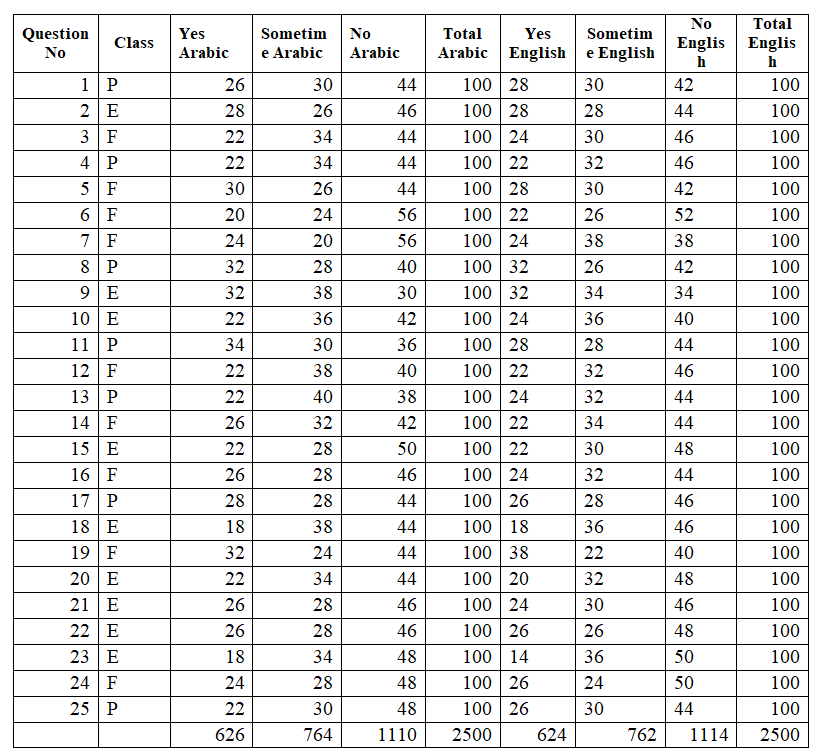
Key sub-scale: F= Functional, E=Emotional, Physical = Physical

The average scores of DHI-JA and DHI-E of normal and dizzy patients was
Figure 5: Comparison between this study and other studies
Figure 6: Comparison between This study and The standardized DHI-E Jacobson et. Al. 1990
Conclusions: There is strong correlation between the DHI-JA and DHI-E. Both DHI-JA and DHI-E have strong correlation between them and Jacobson et. al., ( 1990). The DHI-JA is valid and reliable tool for assessment the severity of dizziness and balance disorders.
It is apparent from tables 1 and Figures 2-4 that the developed THI-A test version is appropriate to assess the tinnitus disability. It has excellent internal consistency of main group and sub-groups like the other versions of different languages. The outcomes of this study are comparable with the previous studies results (El-Beaino M & Eter E. 2017). All show excellent correlation between the scores of total THI-A (scales and sub-scales) the BDI, and the SAI.
4- Conclusions
Evidently, it can be concluded from these results that the developed THI-A test, of this study, is a reliable test to assess tinnitus intrusiveness of native Jordanian Arabic speakers’ population. The clinicians and researchers may use this test as standardized test to assess the intensity of tinnitus and its effects on the patients’ quality of life
5- References
- Szmytke, et al., 2021
- Jacobson & Newman, 1990;
- Domantas, D., 2019
- Wild D, Alyson G, Mona M, Sonya E, Sandra M, Verjee-Lorenz A,., (2005) Principles of Good Practice for the Translation and Cultural Adaptation Process for Patient-Reported Outcomes (PRO) Measures. Value Heal 2005; 8: 95-104. [CrossRef]
Aksoy, S., First, Y., & Alpar, R. (2007). The Tinnitus Handicap Inventory: a study of validity and reliability. Int Tinnitus J;13(2):94-98
Beck, A., Ward, C., Mendelson, M., Mock, J., & Erbaugh, J. (1961). An inventory for measuring depression. Arch Gen Psychol; 4:561-571
Crocetti, A., Forti, S., Ambrosetti, U., & Bo, L. (2009). Questionnaires to evaluate anxiety and depressive levels in tinnitus patients. Otolaryngology Head Neck Surg.;140(3): 403-405.
El-Beaino, M., and Eter, E. (2017). Arabic validation of the tinnitus handicap inventory and the mini-tinnitus questionnaire on 100 adult patients. Clinical Otolaryngology. 10-40.
Heller, A. (2009) Classification and epidemiology of tinnitus, Otolaryngology Clin North Am;36(2):239-48.
James, K., Owens, K., Zaugg, T., Porsov, E., & Silaski, G., (2003). Auditory test result characteristics of subjects with and without tinnitus. J Rehabil Res Dev.;46(5):619-32.2.
Kuk, F., Tyler, R., Russel, D., & Jordan, H., (1990). The psychometric properties of a tinnitus handicap questionnaire. Ear Hear. 11: 434-442
Langguth, B., Kleinjung, T., Fischer, B., Hajak, G., Eichhammer, P., & Sand, P., (2007). Tinnitus severity, depression, and the big five personality traits. Prog Brain Res.; 166:221-225.
Monzani, D., Genvese, E., Marrara, A., Gherpelli, C., Pingani, L., forghieri, M. Rigatelli, M., Guadagnin, T., & Arslan, E., (2008). Validity of the Italian adaptation of the Tinnitus Handicap Inventory; focus on quality of life and psychological distress in tinnitus-sufferers. Acta Otorhinolaryngology Ital ;28(3):126-134
Newman, C., Jacobson, G., & Spitzer, J., ( 1996). Development of the Tinnitus Handicap Inventory. Arch Otolaryngology Head Neck Surgery;122: 143-148
Shaurya, C., Ravichandran, A., and Kumar, S. (2018). Trans-adaptation and Standardization of Tinnitus Primary Function Questionnaire in Hindi. International Tinnitus Journal. 22(1)23-9.
Spielberger, C., Goruch, R., & Lushene, R., (1977). Manual for the State-Trait Anxiety Inventory. Palo Alto, CA: Consulting Psychologists Press
Weber, J., Jagsch, R., Hallas, B., (2008). The relationship between tinnitus, personality, and depression. Z Psychosom Med Psychother.;54(3):227-240.
Yahav, O., Sagit, S., Shulamith, K., & Yehudah R., (2011). A Hebrew adaptation of the tinnitus handicap inventory. International Journal of Audiology 2011; 50: 426–430
Zachariae, R., Mirz, F, Johansen, L., Andersen, S., Bjerring, P., & Pedersen, C., (2000). Reliability and validity of a Danish adaptation of the Tinnitus Handicap Inventory. Scand Audiol; 29 (1):37-43
Zamyslowsk-Szmytke, et al., 2021
Jacobson & Newman, 1990;
Domantas, D., 2019
Wild et al., (2005)


Published by
Dr. Mohammed Al Masri
CEO & Founder
MMC Sheikh Manaa Al Maktoum Polyclinic & Hospital
Consultant ENT, Audiologist, Ph.D.